

The Architecture of Influence: Why Authority is the New Global Currency
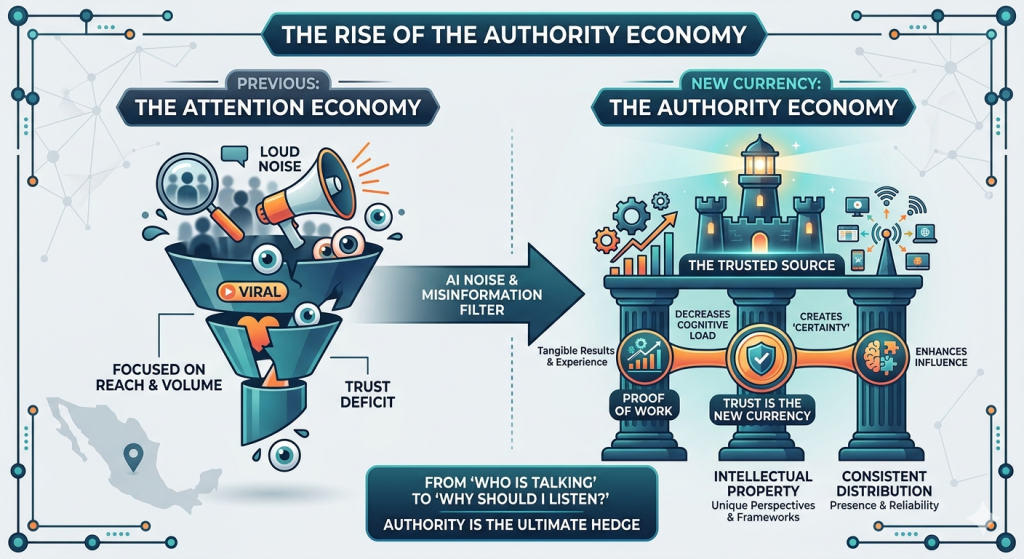
In the traditional economy, power was measured by capital: land, labor, and industrial output. In the digital economy, we transitioned to “attention” as the primary driver of value. But as the internet becomes oversaturated with noise, attention is no longer enough. You can have a million eyes on you and still possess zero influence.
Today, we have entered the Authority Economy. In a world of deepfakes, AI-generated filler, and “fake it ‘til you make it” influencers, authority—defined as the perceived expertise, reliability, and social proof of a figure—has become the scarcest and most valuable asset.
The Psychology of “Why We Follow”
Our tendency to defer to authority isn’t just social conditioning; it’s a biological shortcut. The human brain is designed to conserve energy. Making every single decision from scratch—which supplement to take, which software to buy, which leader to trust—is cognitively expensive.
To solve this, we rely on Heuristics, or mental shortcuts. The most powerful of these is the Authority Bias.
- The Milgram Foundation: Classic psychological studies, most notably the Milgram experiment, demonstrated that humans are hardwired to obey perceived authority figures, often against their own better judgment.
- The Halo Effect: If an individual is recognized as an authority in one niche (e.g., a successful tech founder), we subconsciously project competence onto them in unrelated fields (e.g., diet or philosophy).
- Signaling Theory: In the absence of total information, we look for “credibility markers”—titles, associations, and consistent high-quality output—to determine if someone is worth our most precious resource: trust.
Why Authority Displaced Attention
For the last decade, the mantra was “content is king.” This led to a volume war where everyone shouted as loud as possible to grab a slice of the attention economy. However, three shifts killed the value of pure attention:
- The Trust Deficit: With the rise of “hallucinating” AI and misinformation, users have developed a defensive skepticism. We no longer care who is talking; we care why we should listen to them.
- The Paradox of Choice: Too much information creates paralysis. We seek “curators of truth”—authorities who filter the noise so we don’t have to.
- The High Cost of Wrongness: In fields like finance, health, and technology, the cost of following a non-expert is higher than ever. We are gravitating toward “Skin in the Game” authority.
The Components of Modern Authority
Authority in 2026 isn’t just about a PhD or a corporate title. It is a formulaic mix of three distinct pillars:
| Pillar | Description | The Currency Value |
| Proof of Work | A public record of tangible results and “battle scars.” | Reduces the perceived risk for the follower. |
| Intellectual Property | Unique frameworks or “proprietary” ways of seeing the world. | Makes the authority figure irreplaceable. |
| Consistent Distribution | Being present where the conversation is happening. | Builds “familiarity,” which the brain often mistakes for safety. |
Authority as a Wealth Multiplier
If money is the tool and attention is the fuel, authority is the engine.
When you possess authority, your “customer acquisition cost” drops to near zero. You don’t have to chase; you attract. In a professional context, an authority figure can charge 10x the market rate of a generalist because they aren’t selling a service—they are selling the certainty that comes with their endorsement.
Conclusion: The Shift from Reach to Resonance
We are moving away from an era of “Broadcasting” and into an era of “Expertise.” The winners of the next decade won’t be those with the most followers, but those with the most trusted followers.
In the new currency exchange, 1,000 people who view you as an ultimate authority are worth more than a million people who simply know your name. Authority is the only asset that AI cannot easily replicate and that market volatility cannot easily devalue. It is the ultimate hedge in an uncertain world.
